Company platforms, AI agents, AI content generation, computer vision, data and engineering tools.
Featured · current role
Blue House Films: the company platform
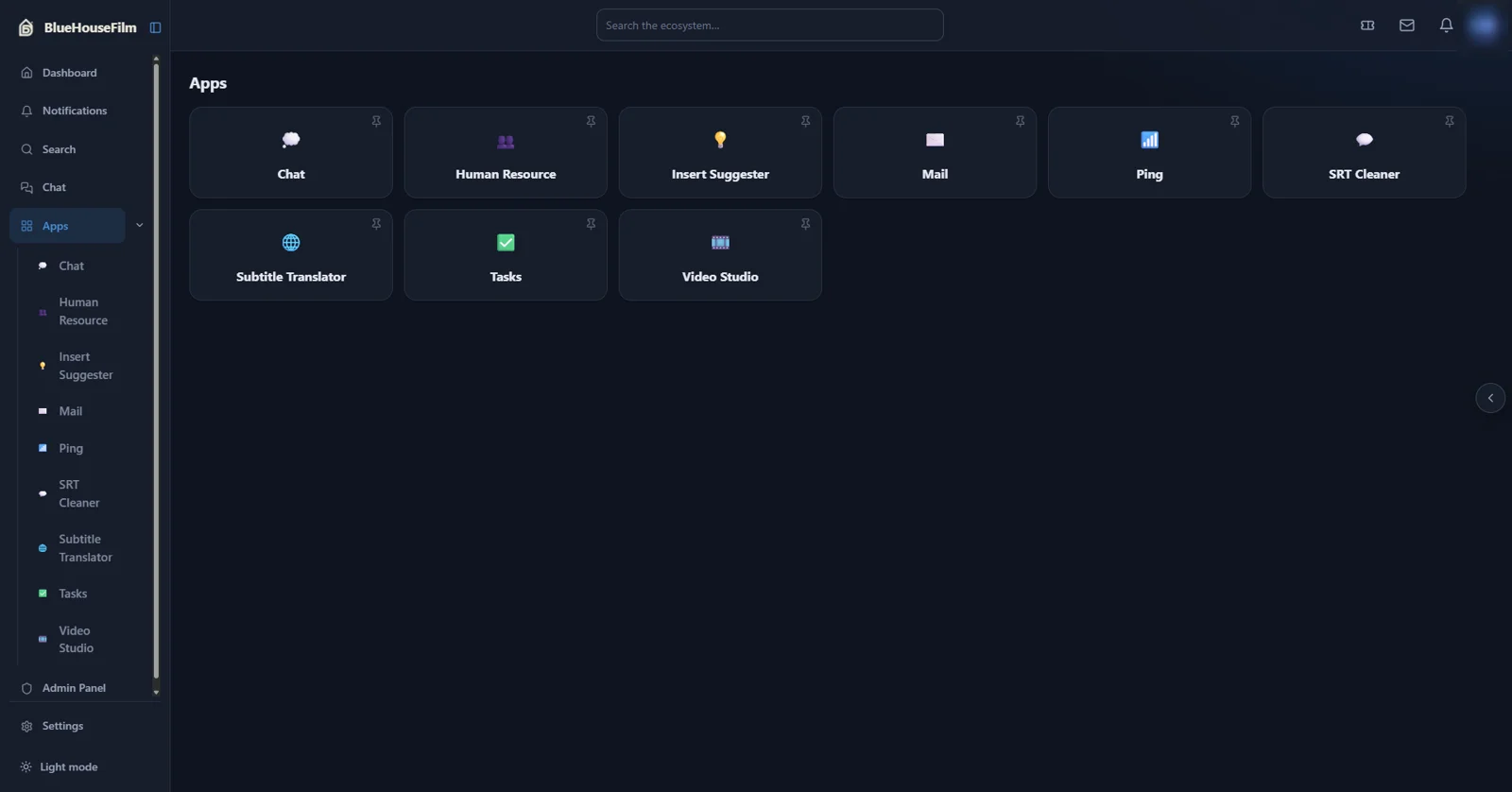
Blue House Films is a film and social media company of about 100 people. I joined in September 2026 as its AI Specialist, to help the team work faster and more accurately with less repetitive work. I started by replacing scattered tools and manual workflows with one connected internal platform, and shipped 9 tools to production in my first six weeks, and I've kept building more since. On a typical day 50–60 staff use the platform: about 55 use Chat, 50 the Task Manager and 15 the SRT Cleaner.
As the main developer on the 3-person R&D team, I own the platform end to end. I design and build the tools, host and secure the server, and set up the company's GitHub, automated backups and CI/CD on GitHub Actions: pull requests are tested, security-scanned and checked for leaked secrets, and backend changes deploy only after the tests pass. I also review other developers' code, supervise the interns, train employees on each new tool, and run regular AI workshops for the developers.
Ecosystem: one platform for the whole company
BeforeEvery employee had their own tools and their own API keys, with nothing connected. Onboarding a new person was a mess.
AfterOne connected platform and one source of truth. Every tool plugs into it as a plugin, and everything can be tracked.
- Onboarding: a new hire used to collect colleagues' contacts one by one, then download, set up and create an account for each tool. Now they get one account, with colleagues already in chat, company email ready, and the tools their role needs already available.
- Offboarding: people who left used to keep access to everything. Now, when HR marks someone as terminated, their sign-in is disabled, every session on every device is ended, and the action is logged in the security log.
- AI API keys: employees used to buy their own keys. Now company keys are encrypted and managed in one place. Neither staff nor the tools ever see a key: a tool sends its request to the platform's broker, which checks the person's permission, adds the key on the server, makes the call and returns only the result. It covers 11 outside services, from Anthropic and Gemini to ElevenLabs and Google Docs, with retries and circuit breakers so one failing provider can't take a tool down.
- Security at the core: the server checks every request against the person's role, and anything not allowed is refused. Two-factor sign-in is set per role, sessions last 15 minutes, a sign-in from a new device sends an alert, and anyone can log out of every device at once. A security review of 18 attack scenarios added detectors for password and two-factor guessing.
- Plugin design, so each tool (HR, tasks, chat, mail) can be built and shipped on its own.
- Self-hosted on an Oracle Cloud VPS that I set up, secure and monitor through the admin panel, with nightly encrypted backups kept outside the country on Cloudflare R2, locked for 30 days so no one can change or delete them, not even an admin. A full restore has been tested.
- Watches itself: every 5 minutes it checks disk space, backups, outgoing email and suspicious sign-ins, and alerts the admins. Urgent problems go to the owners too and repeat until someone takes them on. A tool that keeps failing is switched off automatically without affecting the rest.
- Developer documentation I wrote: architecture guide, plugin guide, runbook and architecture decision records, so other developers can build plugins on their own.
- On-laptop AI: plugins can run AI models on employees' own laptops. Models download into a shared cache and are used only if they match their fingerprint, and the engines that run them are built into the signed desktop app, so a web page can never introduce code.
- Desktop app: signed releases with automatic updates; new versions go to chosen roles first and can be halted at once. It starts with the computer, keeps running in the tray, and shows unread counts on the taskbar or Dock. Windows and macOS.
- Platform services: an audit log of every permission decision, a durable event system, scheduled jobs and reminders, alerts in the app or by email and Telegram, and recorded acceptance of each version of the terms of use.
- Scale: about 70,000 lines of code, 1,400+ automated tests and 60 architecture decision records.
DjangoPostgreSQLDjango-Q2 jobsReact + ViteTauri desktop appRBAC + audit log
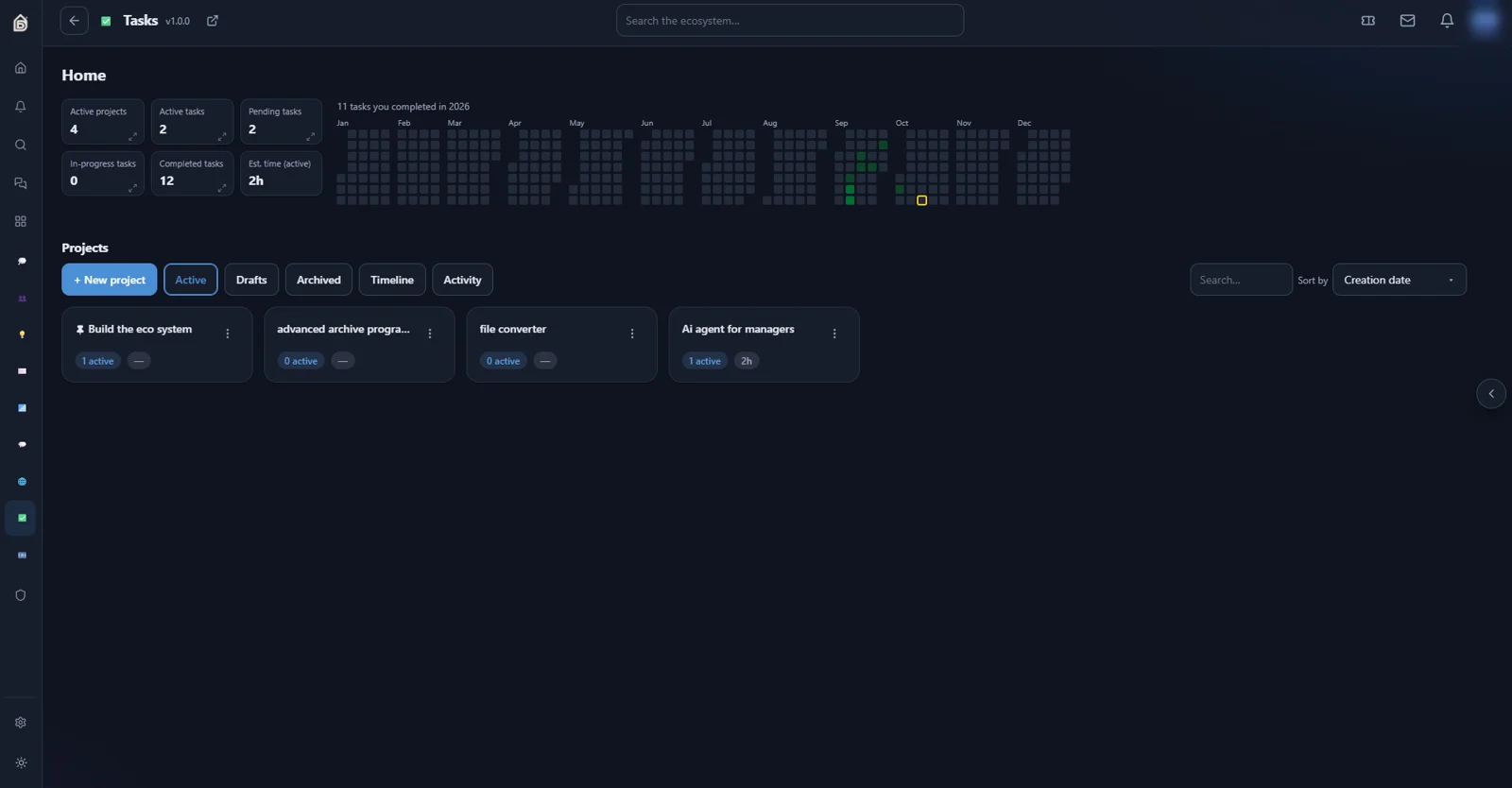
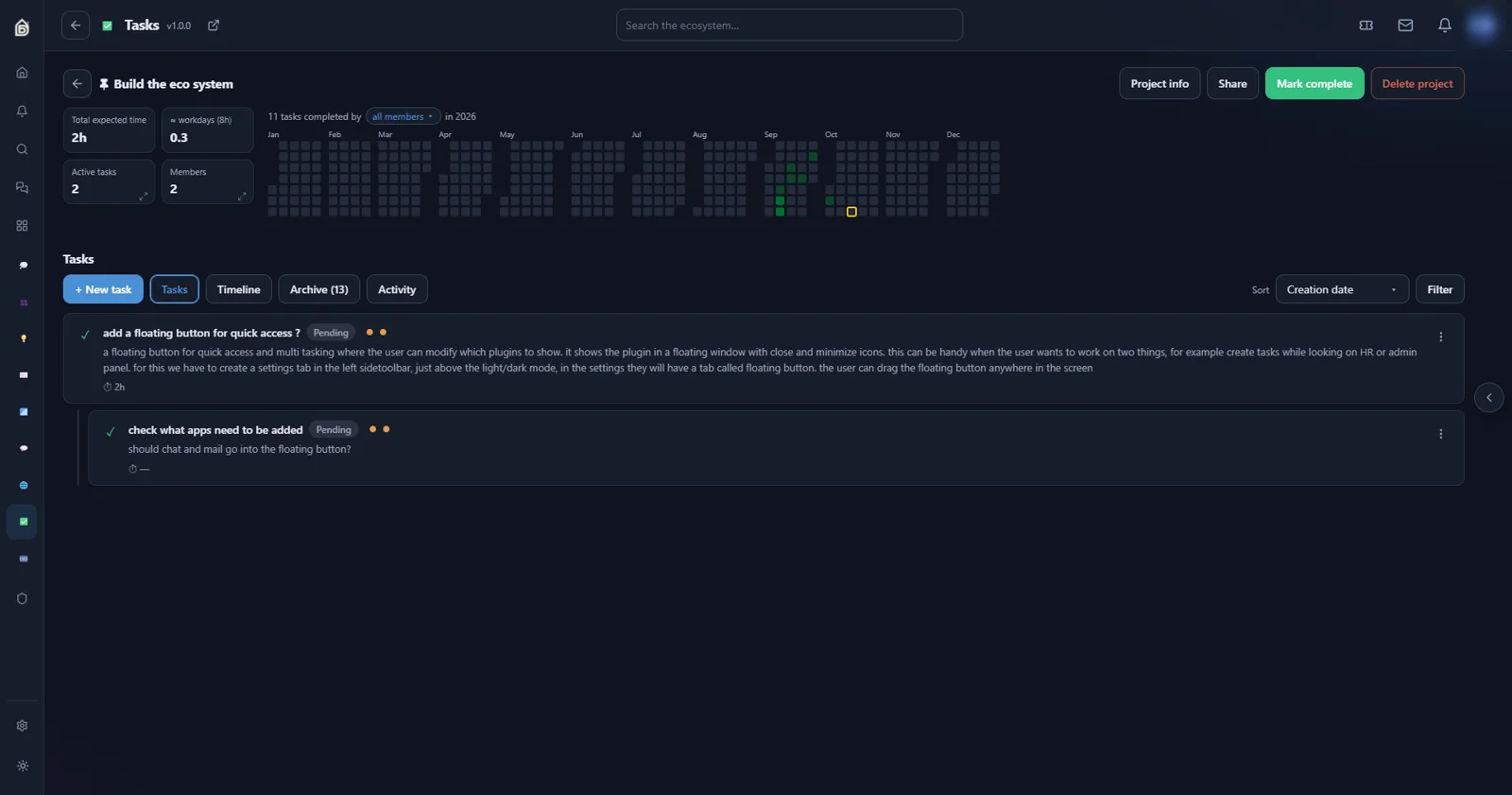
Task Manager
BeforeTasks were handed out verbally, by email or on WhatsApp, so they got forgotten, deadlines were missed and managers had to chase people for updates.
AfterEvery task has an owner, a status and a deadline. Managers see progress live instead of chasing people, and changes appear on every device instantly.
- Project dashboards with active, pending and completed counts, time estimates and workday totals.
- A yearly activity heatmap per person or per project, so managers can see who is delivering.
- Sub-tasks, a timeline view, an archive and an activity log.
ReactDjangoLive updatesRole-based accessWeb + desktop
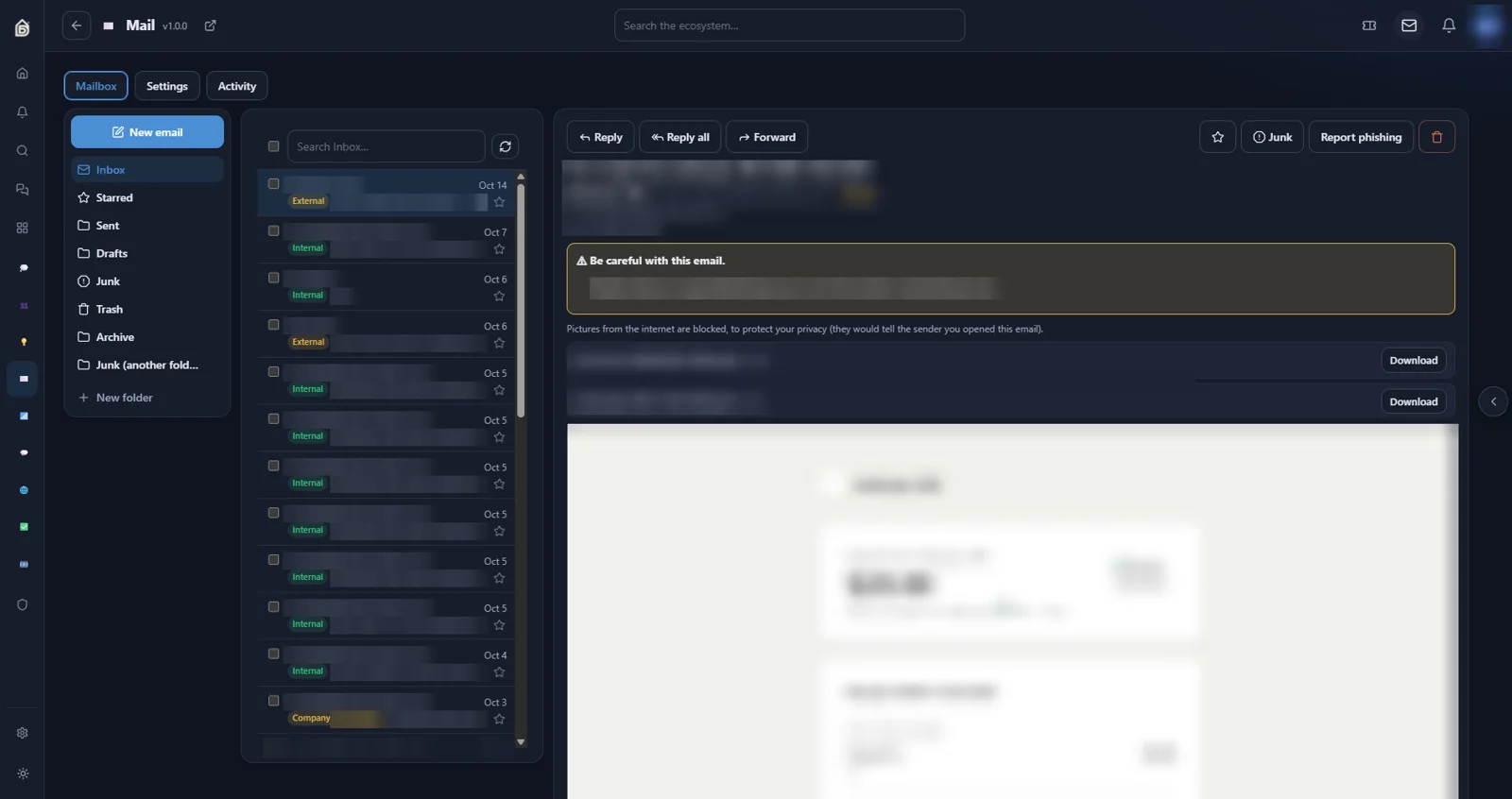
Mail
BeforeStaff had to log in to Bluehost webmail or set up email on their phones and Outlook, which was hard for non-technical people. Important emails were missed or answered late, and the company had faced phishing attacks with no protection beyond the basics.
AfterCompany email inside the platform with just an email and password, and instant notifications. Every message is checked for phishing and malicious content, and suspicious mail is clearly flagged.
- Every sender labelled Internal, External or "Company, not verified", so spoofed company addresses stand out.
- Warns when replies would go somewhere other than the sender, with one-click "Report phishing".
- Checks sender authentication (SPF, DKIM, DMARC), catches lookalike company domains (such as a "1" for an "l" or Cyrillic letters), flags risky attachments like macro-enabled files, and shows a dangerous link's real address before it opens. All checks run on our own server, with no outside service.
- Remote images blocked by default, so senders can't track when an email is opened.
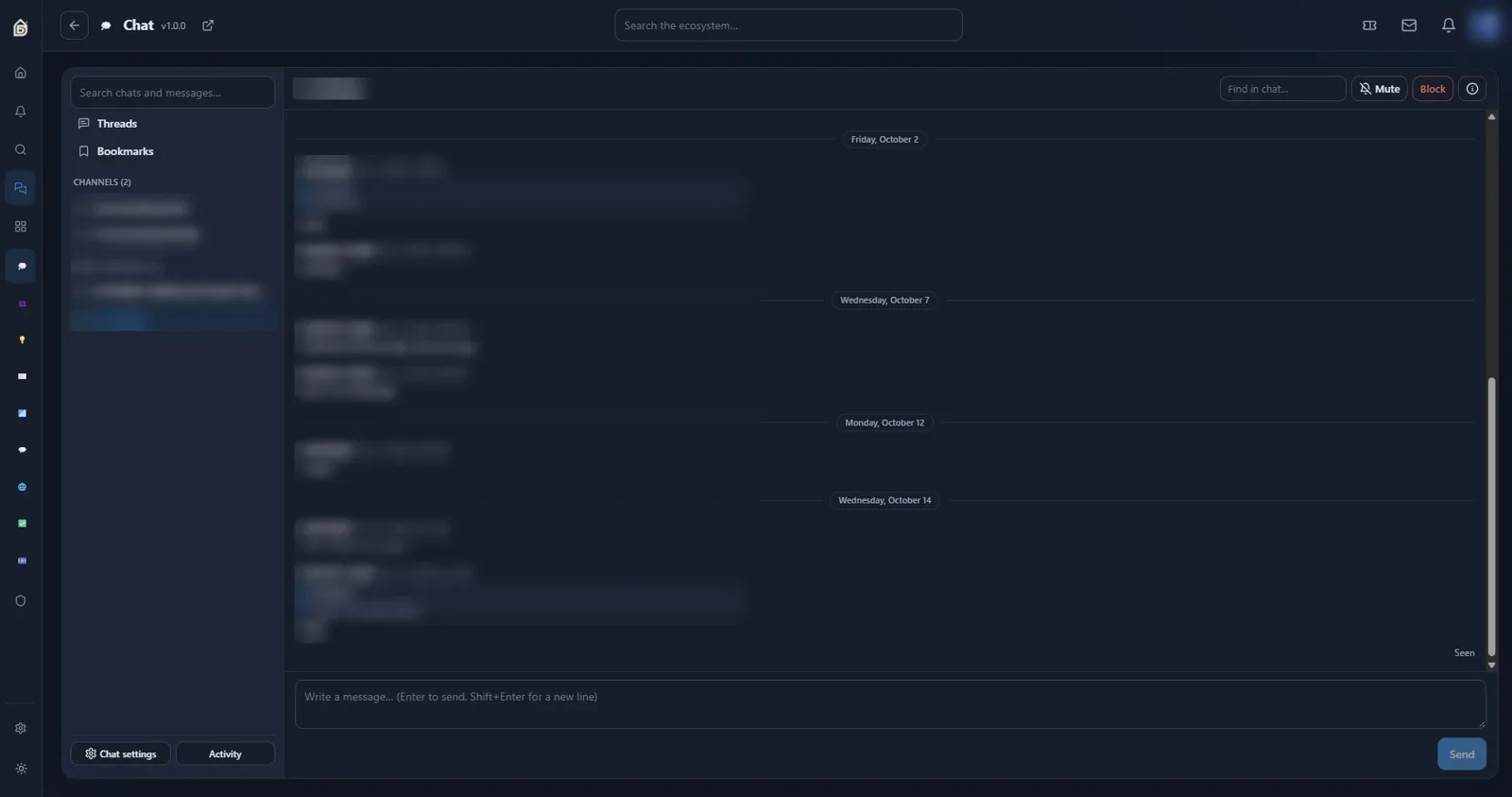
Chat
BeforeWork talk was split between Slack, WhatsApp, email and conversations, depending on the person. Private numbers got shared and announcements were missed.
AfterEveryone now uses one internal chat instead of paid Slack seats. It's trackable, abuse can be reported to HR with proof, and nobody has to share a private number.
- Private channels, direct and group messages, threads and bookmarks.
- Replies, search across all chats, read receipts, mute and block.
SRT Cleaner
Co-developed
BeforeThe list of words to censor in subtitles was passed around on WhatsApp and email. Remote staff missed updates and each writer censored differently, so banned words reached published videos, posts got flagged or restricted, and videos had to be re-edited and re-uploaded.
AfterA manager updates the word bank in one place and everyone has it instantly. Censoring follows one standard method, and a 30–90 minute manual editing task now takes seconds. It's in daily use across the company's news platforms.
- Cleans subtitles in English, French and Arabic, and never touches the timestamps.
- Moved from a standalone desktop tool into the platform, with a shared word bank and an activity log.
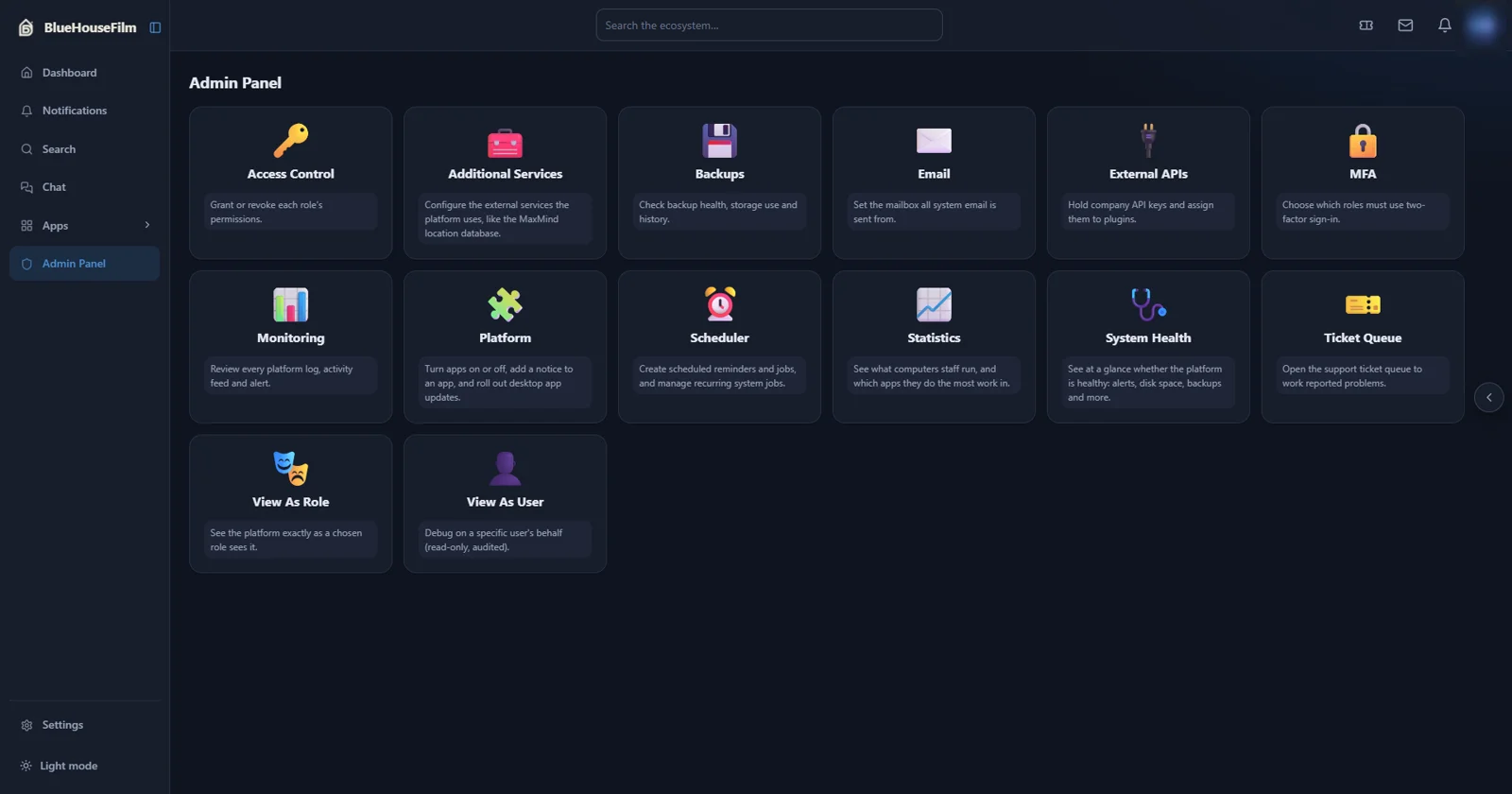
Admin panel
BeforeEvery system was checked by hand: logging in to each provider's website and checking storage and backup sizes manually. Some things weren't watched at all.
AfterOne dashboard shows server health, backups, logins and malicious access attempts, and sends an alert when something needs attention.
- Per-role access control, plus rules for which roles must use two-factor sign-in.
- Company API keys held centrally and assigned to plugins, so staff never handle keys themselves.
- System health, monitoring, backups and alerts, including logins and malicious access attempts.
- "View as role" and audited, read-only "view as user" for safe debugging.
- Scheduled jobs, platform updates and the support ticket queue.
HR
BeforeEmployee details were kept apart from the tools people used. Access to each tool was given and removed by hand, people who left kept it, and nobody could see who changed what.
AfterHR and the owners manage every employee in one place. Setting someone's role gives them exactly the tools they need, every change is logged with who made it, and marking someone as having left cuts their access to every tool at once.
- Employee records: job title, contract type and dates, ID details and status. Assigning a role in the editor also sets the person's access.
- Self-service profiles: each employee updates their own photo, phone, address and emergency contact.
- Cases: when someone reports a chat, HR gets a case. HR can read the reported conversation, talk privately with the reporter, and close the case with a written verdict. The people reported never see the case.
- A full change history for every record and case, plus automatic clean-up of old records.
Ticket system
Employees report bugs, security issues and feature requests from inside the platform. The developer chats with the person who raised the ticket and marks it resolved, so nothing gets lost in messages.
Device statistics
BeforeWhen the company wanted to buy or subscribe to new software, nobody could tell whether staff laptops and computers could run it.
AfterA dashboard collects the hardware specs of every staff computer, so the company can check before buying, and developers know what hardware to build for. It guided the decisions when the macOS version of the platform was developed.
A second tab measures plugin usage: the real work done in each tool and its top users, so the company can see which tools people have actually adopted.
Newsroom engine
A news-intelligence engine for the company's newsrooms.
- Collects news from RSS feeds, GDELT and outlet scraping, then groups articles about the same event into stories across languages using AI embeddings.
- Links names to Wikidata, tags topics with AI, and searches by tags, words and meaning.
- Raises breaking-news alerts and shows verification signals: who confirms a story and where it started.
- Each outlet has a research profile covering ownership, funding and leaning. It starts with 54 outlets in Arabic, English and French.
- A newsroom screen with movable dashboard panels, a search builder, leaderboards of which outlets break stories first, and exports to CSV, JSON and PDF.
- Alerts and AI digests in the app or by email, Telegram and Slack. AI use has daily request and spending caps.
- Built in one week by studying a leading commercial tool (NewsWhip Spike) feature by feature, and it replaced the company's NewsWhip subscription. About 9,500 lines with 257 automated tests.
DjangoPostgreSQL + pgvectorReactAI embeddings
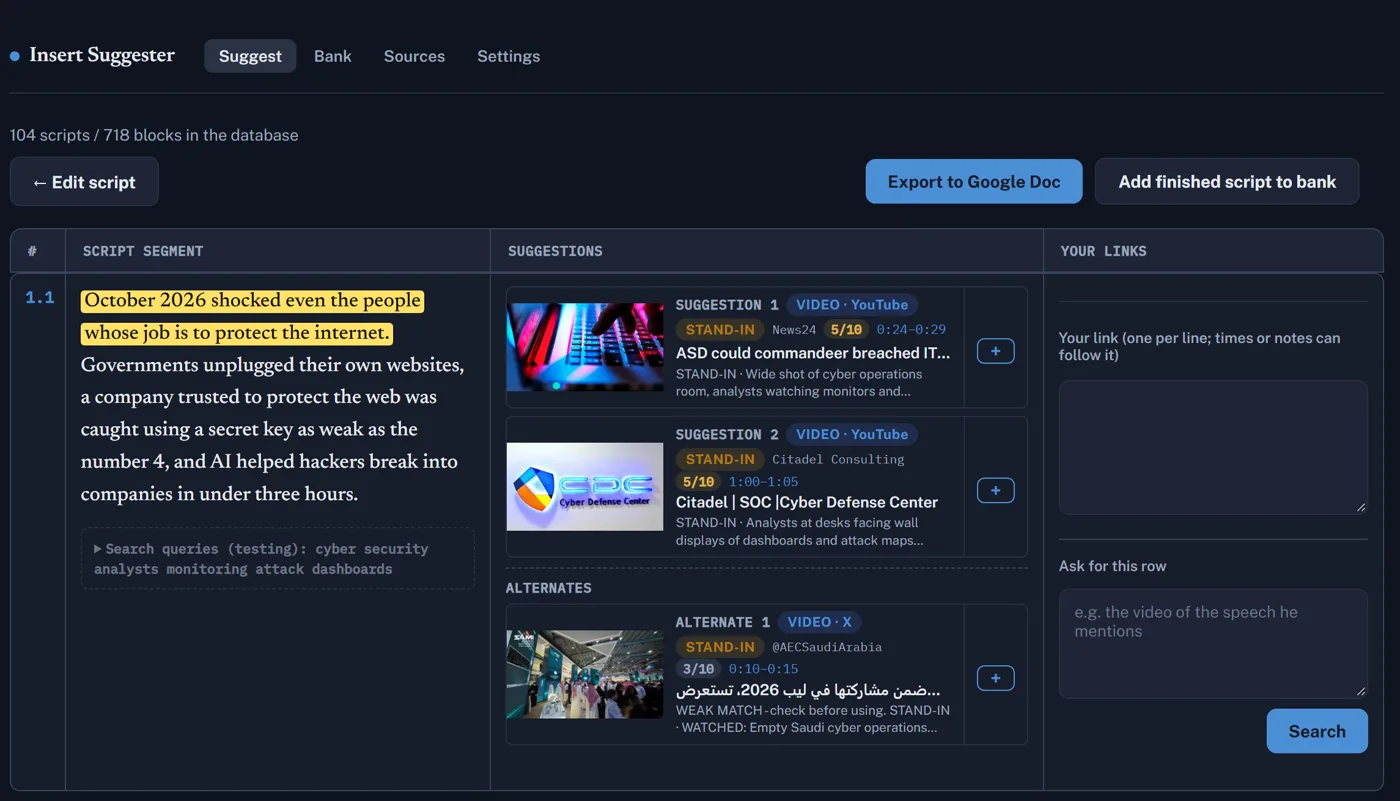
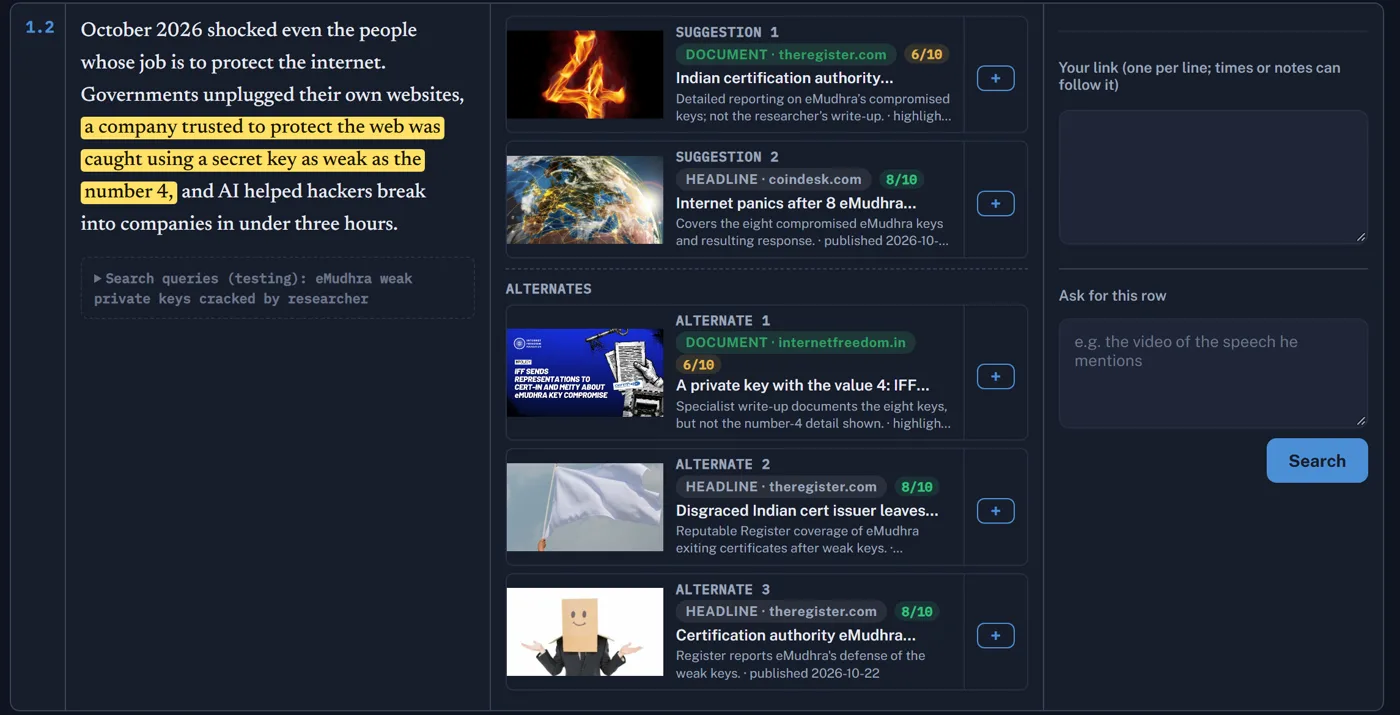
Insert Suggester
BeforeFor every script, writers worked out what each sentence was about, searched for sources and videos, then read or watched each one before adding it. It took hours, sometimes days.
AfterThe tool does this automatically in under 15 minutes, depending on the size and complexity of the script.
An AI tool for script writers, designed to read each block of a video script, work out what it's really about, and propose visual inserts (videos, images, articles, X and Telegram posts) through live search, guided by a bank of past scripts. Candidates are judged by looking at their actual video frames. When the editor is done, the tool writes the chosen inserts straight into the script's Google Doc. It uses the Google Docs API through a company Google service account (a robot account the doc is shared with), and the platform keeps that account's key, so the tool itself never holds it. The export adds a two-column table at the end of the doc in one batch: each part of the script, highlighted, next to its chosen links and the editor's notes.
It runs as an automated multi-step AI pipeline: one step plans what each block needs, live search gathers candidates, and separate AI judges score the videos, posts, headlines and documents. Every AI step has a strict JSON schema, so a bad output is caught by code and never passed on. Editors rate the results in a Reviews tab, and each rating is tied to the AI judge that scored that item, so the judges can be evaluated against real use and improved. Other safeguards include multilingual embeddings for the script bank and dates that are never copied from another event.
AI agents and automation
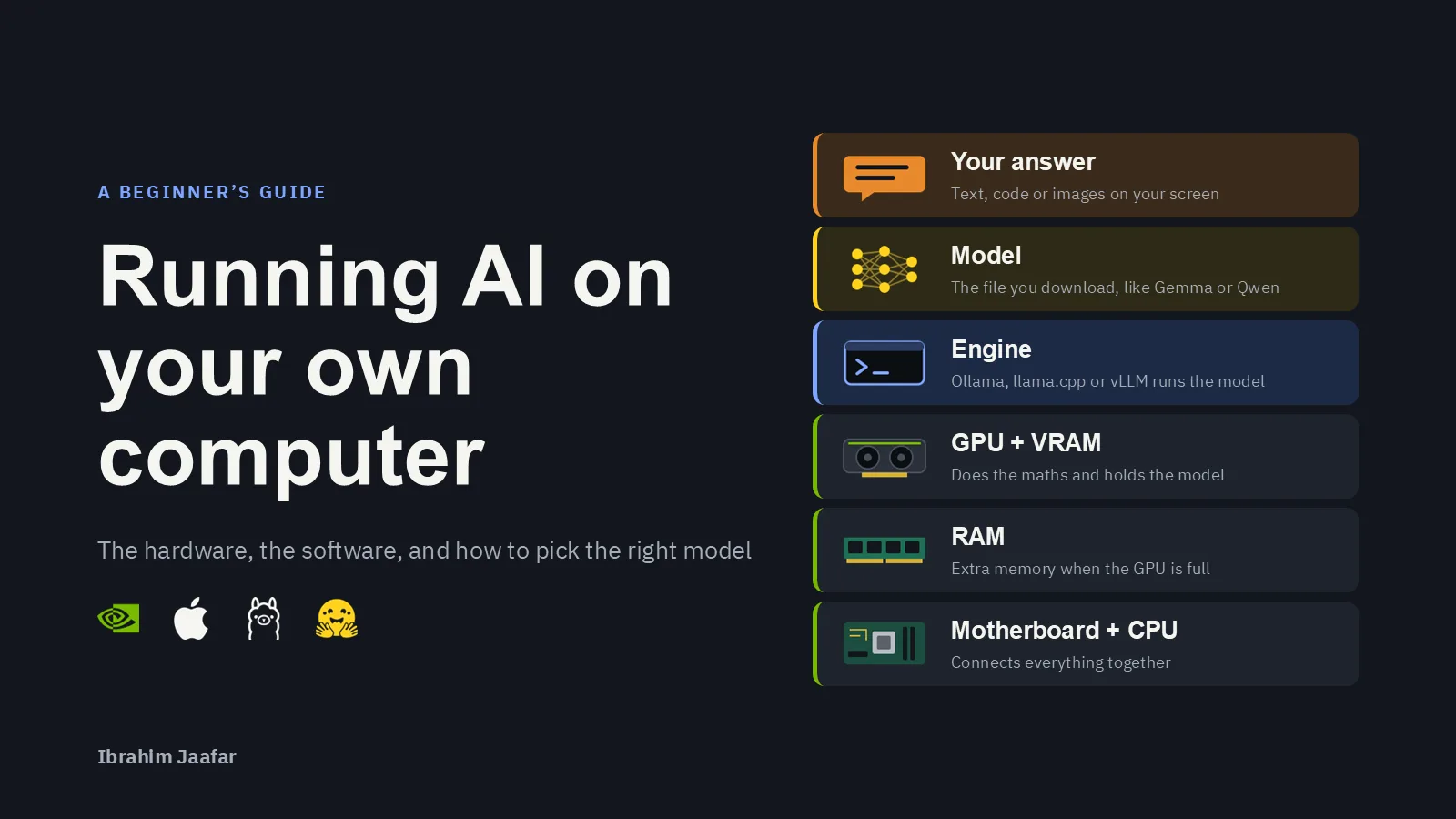
I've been building with AI since ChatGPT first came out in late 2022. Today I use Claude Code and other agentic tools every day, and I build my own agents for jobs that would otherwise take hours by hand.
Agency report automation (live demo)
Live · n8n · GoHighLevel API · Meta Conversions API · Gemini
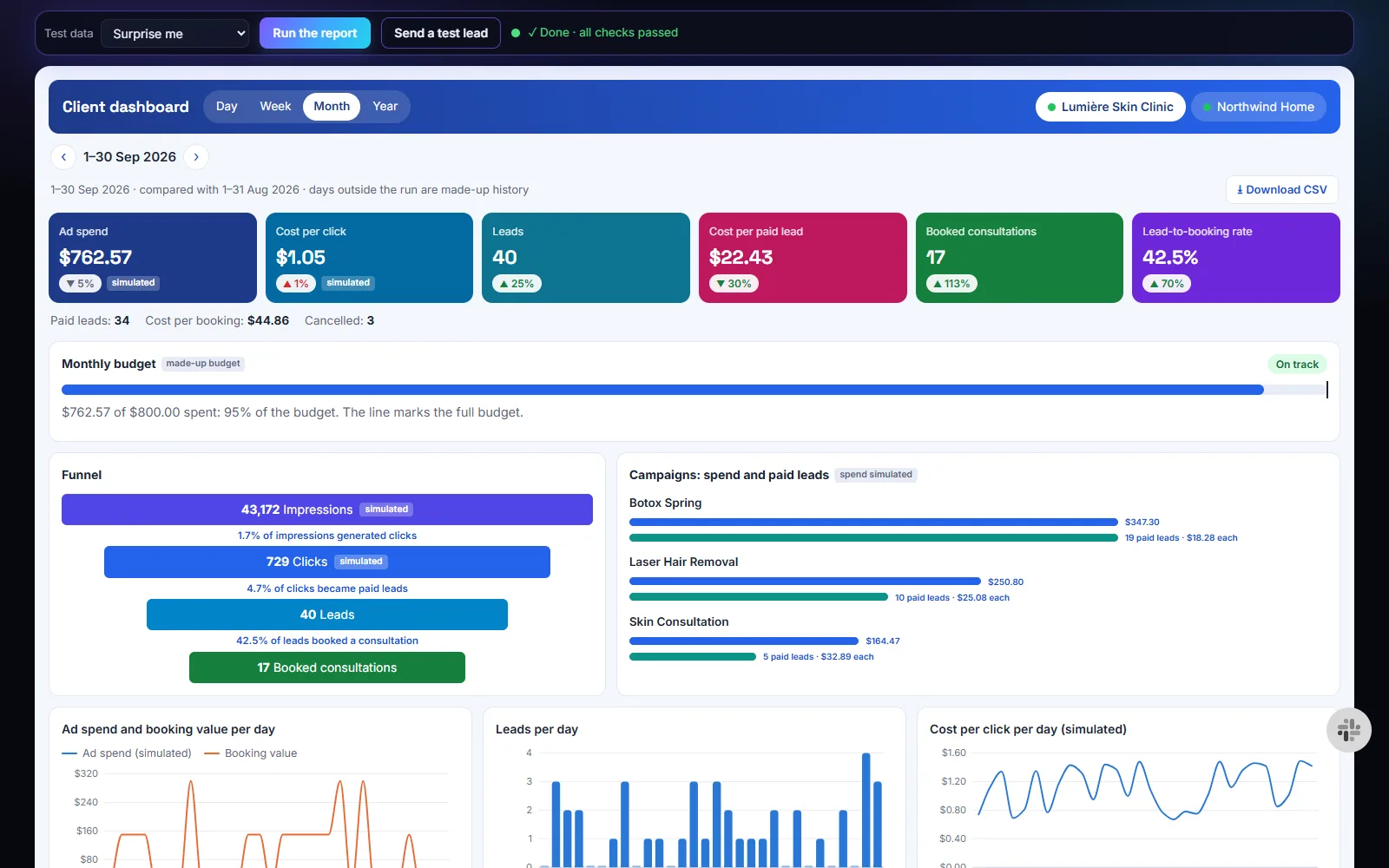
A marketing report for two made-up agency clients, a skin clinic and a home-goods store. It pulls each client's leads and ad spend, sends conversions to Meta, checks the data for mistakes in plain code, and writes a short summary a client can read, for any day, week, month or year. Visitors can run it on clean data or break the data on purpose and see what the checks catch, explore the results on a client dashboard, and send test leads to watch them arrive.
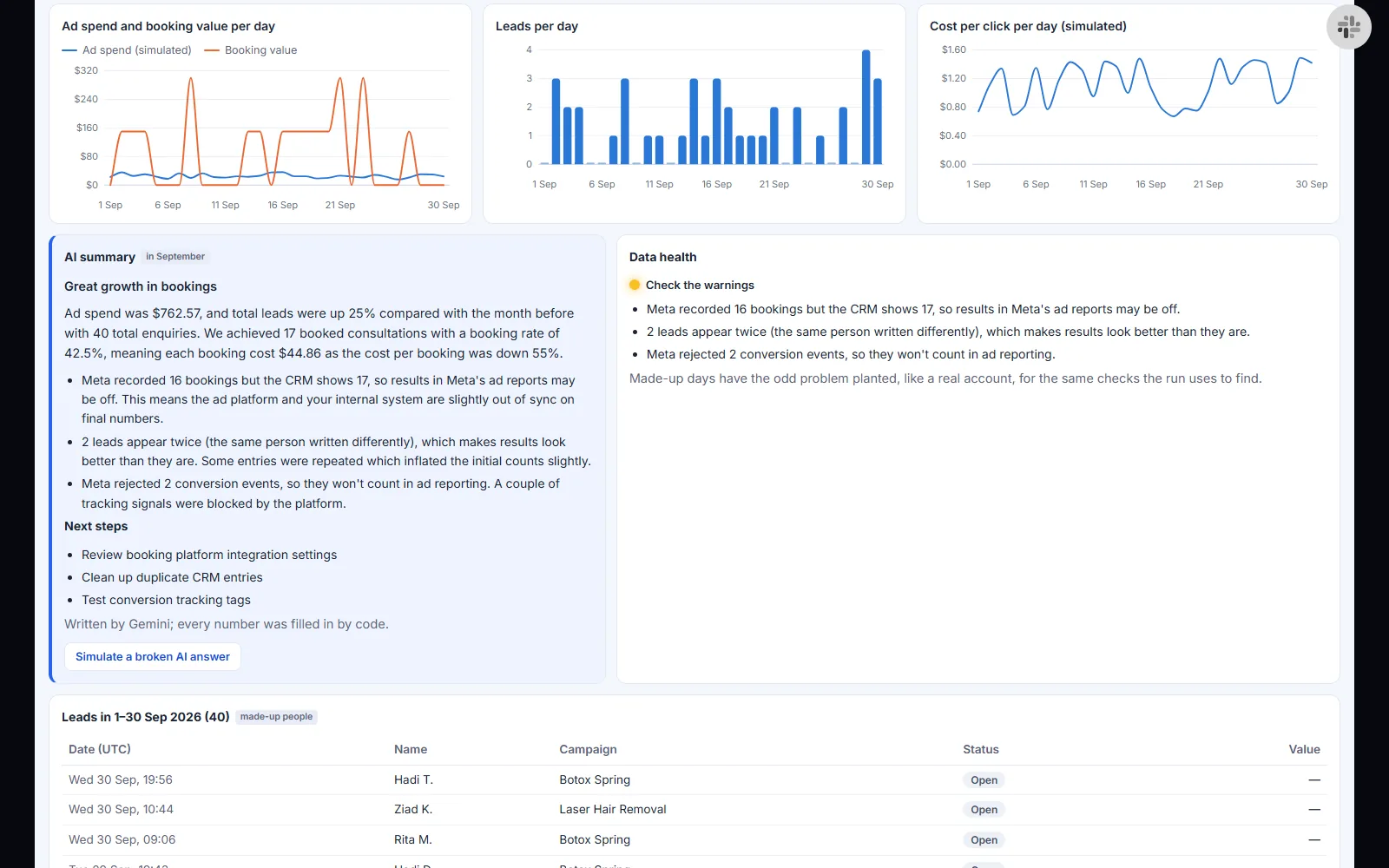
- Client dashboard: each client gets a dashboard like a real agency report: spend, cost per click, leads, cost per lead and results, each with its change (green when it's good news), a funnel from impressions to bookings or orders, spend and cost per lead for each campaign, spend against a budget, charts, data health, the leads behind each view and a CSV download. Day, week, month and year views open on the current period so far, updating live, with arrows to step back to earlier ones; they are added up from daily totals, with costs and rates worked out again from the sums, never averaged. Impressions, clicks and spend, the budgets and the history outside the run's 7 days are simulated and labelled as such.
- Checks in code, not AI: leads with no source, duplicates written differently (+961 vs 0, capital letters), Meta and CRM not matching, totals that don't add up, unusually large orders and events Meta rejects. They run on whatever period is on screen, with the same code as the run.
- Edge cases handled: an empty week shows "no leads" instead of dividing by zero, organic leads don't skew cost per lead, cancelled bookings are left out, and Arabic or emoji names survive hashing.
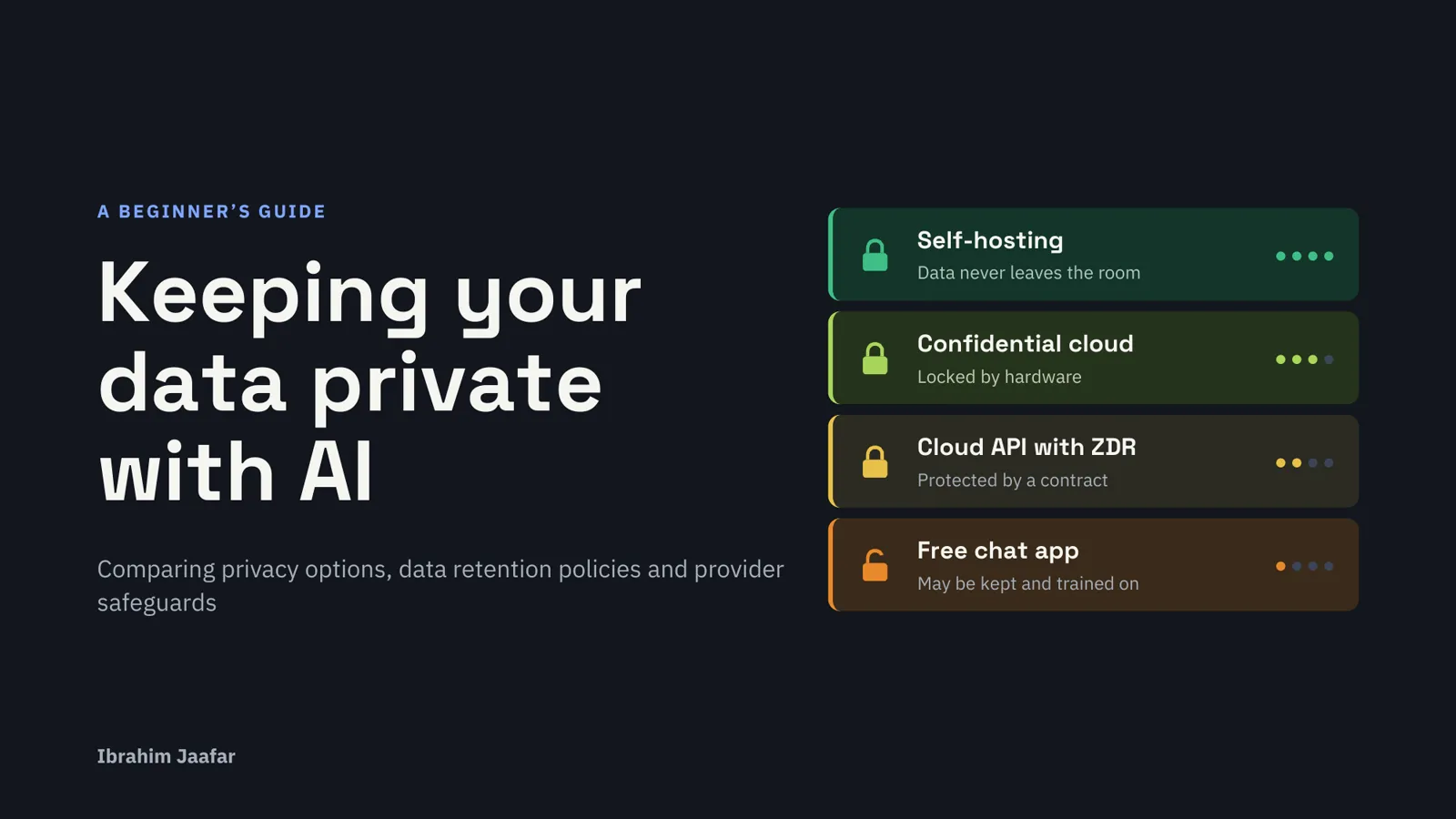
- Private by design: the AI only sees totals and warnings, never names, phones or emails. Personal fields sent to Meta are SHA-256 hashed.
- AI on request, kept honest: a summary of whatever period is on screen, written when asked; the server works out the figures itself. It never types a number; it writes placeholders, each next to its own label, and the code fills in the real values. Its answer must also follow a strict JSON schema. A broken answer is refused and a template summary is used instead.
- Live: n8n workflows on a free server: one plays the customers of the last 7 days and saves them in a GoHighLevel sandbox; the report a real client would get reads them back, sends the conversions to Meta's Conversions API and posts an alert to Slack when a check fires or a run fails; another asks Gemini for a summary on request, and another sends test leads through GoHighLevel and Meta one at a time. The logic is covered by 204 automated tests.
Try the demo →
Word Fix: correct a misspoken word in a video
n8n · F5-TTS · wav2vec2 forced alignment · Whisper · ffmpeg · Node.js · Python · Docker
Built for a content creator. Before, one wrong word meant re-shooting and re-editing that part, which took hours, or adding an on-screen note about the mistake, which looked unprofessional. Now they click the wrong word in the transcript and type the right one. It's re-spoken in their own voice and room sound, in the same place in the video, and each fix takes seconds.
- Speech editing, not text-to-speech: an AI model (F5-TTS) hears the audio on both sides of the word and re-speaks only that stretch, so the voice, pace and joins to the next words match.
- Cuts in the right place: Whisper's word times are 0.2–0.5 s off, so a forced aligner finds where each word really starts and ends.
- Every take is checked: a speech model listens to each new take and keeps one that has the new word and no trace of the old one, trying up to 3 times.
- Same room, same length: the room's background noise is measured in nearby pauses and filled in under the new word, and the video never changes length, so it stays in sync.
- Editor: the transcript follows the video. You can preview and retry, fixes run in the background one after another, a word can be fixed everywhere it's said, any fix can be undone, and subtitles can be burned in on export.
- Runs on the creator's own PC: n8n in Docker and a local GPU voice server; only the transcription goes to the cloud. 48 automated tests on the audio engine, plus an end-to-end test.
Hermes multi-agent system on Telegram
Hermes Agent · Telegram · web scraping · Android emulator automation
Four bots, each with its own job. An orchestrator hands out the work and passes requests between them. I use them almost every day, for myself and for friends.
- Car specialist: takes a licence plate, scrapes the car's details, then uses the VIN to check recalls and cross-check the data on other sites. It then starts an Android emulator, turns on a VPN, opens a specific app and fills in the data to pull the car's history, with no manual steps.
- Trading analyst: reads the news, pulls live MetaTrader 5 data, backtests strategies, and shows how the news moves the market on a live dashboard.
- Coding bot: writes code in my own style and conventions.
- Orchestrator: delegates tasks and acts as the middle man. For example, when the trading bot needs new code, it routes the request to the coding bot.
- Lean by design: each bot has its own SOUL.md and only the skills and tools its job needs, so it doesn't carry extra context or spend extra tokens.
- Kanban hand-offs: the bots deliver tasks to each other through a shared kanban board, so every hand-off is tracked.
Furniture CAD-to-render pipeline
Claude Code · Blender MCP · Gemini image generation · SolidWorks
Product photos for a furniture line without a photo shoot. Products designed in SolidWorks are placed into photoreal scenes by Gemini image generation. Because image models get the scale of objects wrong, Claude also builds each scene in Blender through MCP, using the real furniture dimensions.
- 32 reusable scene scripts: importing parts, building rooms, applying materials, lighting and final polish.
- A written standards library (walls, doors, windows, lighting and camera, furniture clearances) that Claude reads before building, so rooms come out at real-world sizes.
- Automated checks that measure furniture clearances and catch overlapping objects before rendering.
- Calibrated scanned fabric materials and Poly Haven textures and lighting for photoreal results.
Mosaic: order-to-production system
Next.js · Supabase · Cloudflare
My own furniture business, still in development: an online store with an admin panel. When an order comes in, the system shows exactly which manufacturing files to cut. A strict code covers every part of every product and its variants, so each order maps straight to production.
- 21 coded designs so far. Each one links its SolidWorks part files and sizes, and each variant records which parts it is cut from.
- Customers pick the wood or colour for each material, and the price is calculated from real costs: materials, edge banding, hardware, services and markup.
- Admin sections for materials, suppliers, hardware, delivery, categories and the blog, so the whole business runs from one place.
- Storefront with shop and product pages, room collections, cart, customer accounts with delivery addresses and order history, and a blog.
Other projects
AI content generation, computer vision and data tools.
MoneyPrinterTurbo Extended: AI short-video generator
Python · FastAPI · React · CLIP / SigLIP-2 · Whisper · FFmpeg
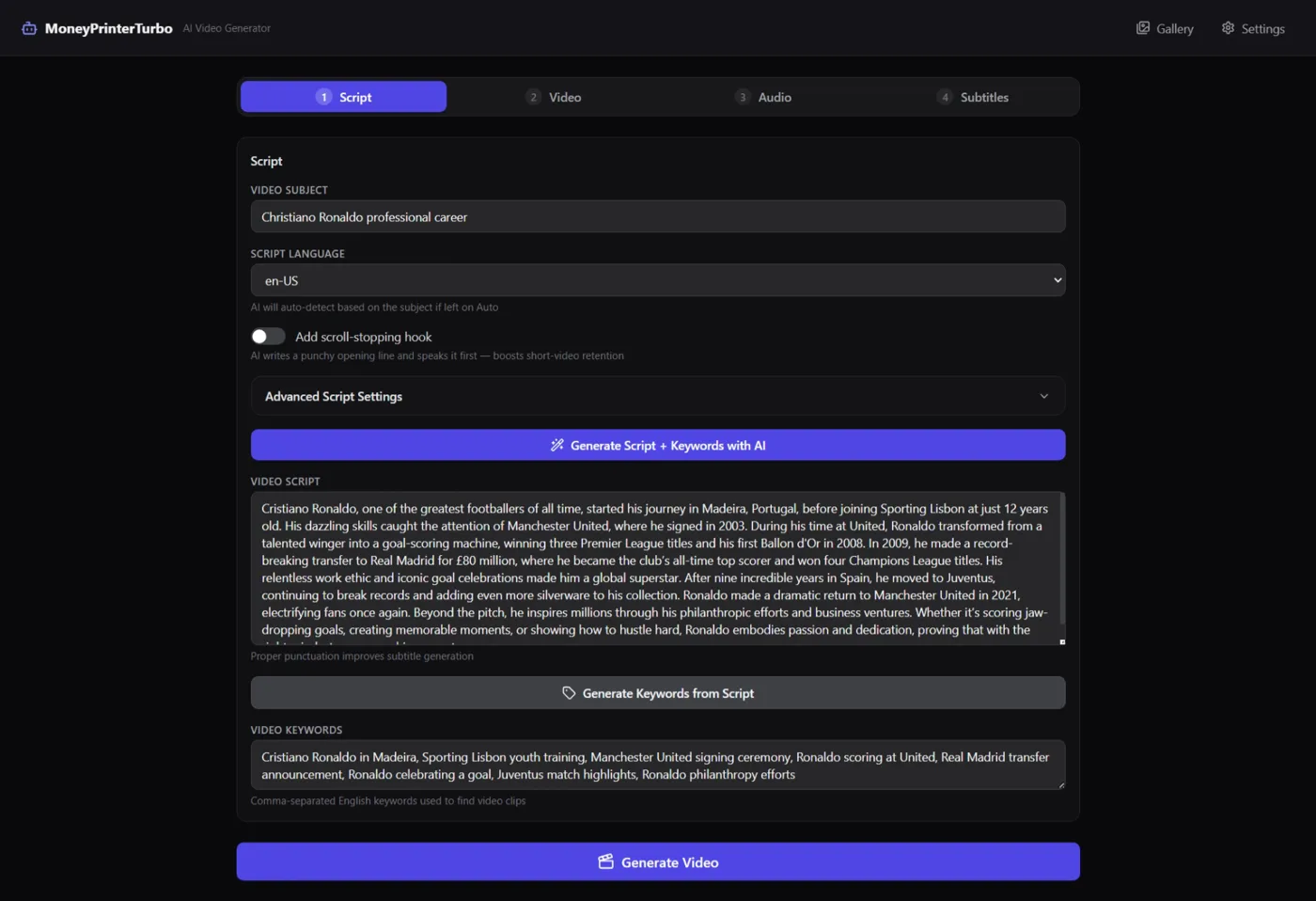
Freelance project for a client who needed more control than the open-source MoneyPrinterTurbo gives. That tool writes a script, narrates it and assembles stock footage into a video. I replaced its interface with a React app and added AI matching between clips and script, so the footage fits what is being said. About 5,300 new lines of code, and the client was satisfied with the result.
- Footage that matches meaning: the script is split into sentences, each candidate clip's frames are scored against the sentence with CLIP/SigLIP, and clips are assigned across the whole video at once (Hungarian algorithm) so the best matches aren't used up early.
- AI script helpers: writes an attention-grabbing opening hook and turns each part of the script into precise footage search terms.
- More footage sources: added YouTube (with browser-session sign-in), Wikimedia and Coverr alongside Pexels and Pixabay; every clip is trimmed and tagged with its source.
- Clip-review editor: before rendering, the operator can swap a clip, search again with their own keywords, upload their own footage, stretch a clip across several sentences, trim it, see which clips are already used, then approve.
- Speed: frame analyses are cached and computed in parallel in the background, and low-quality frames are scored down.
- Voice and subtitles: Chatterbox voice cloning on the GPU and ElevenLabs, with word-level subtitle timing from faster-whisper.
- A gallery of past clips, and automated tests for the new parts.
PromptForge: multi-provider AI image platform
Next.js · TypeScript · SQLite · AES-256-GCM
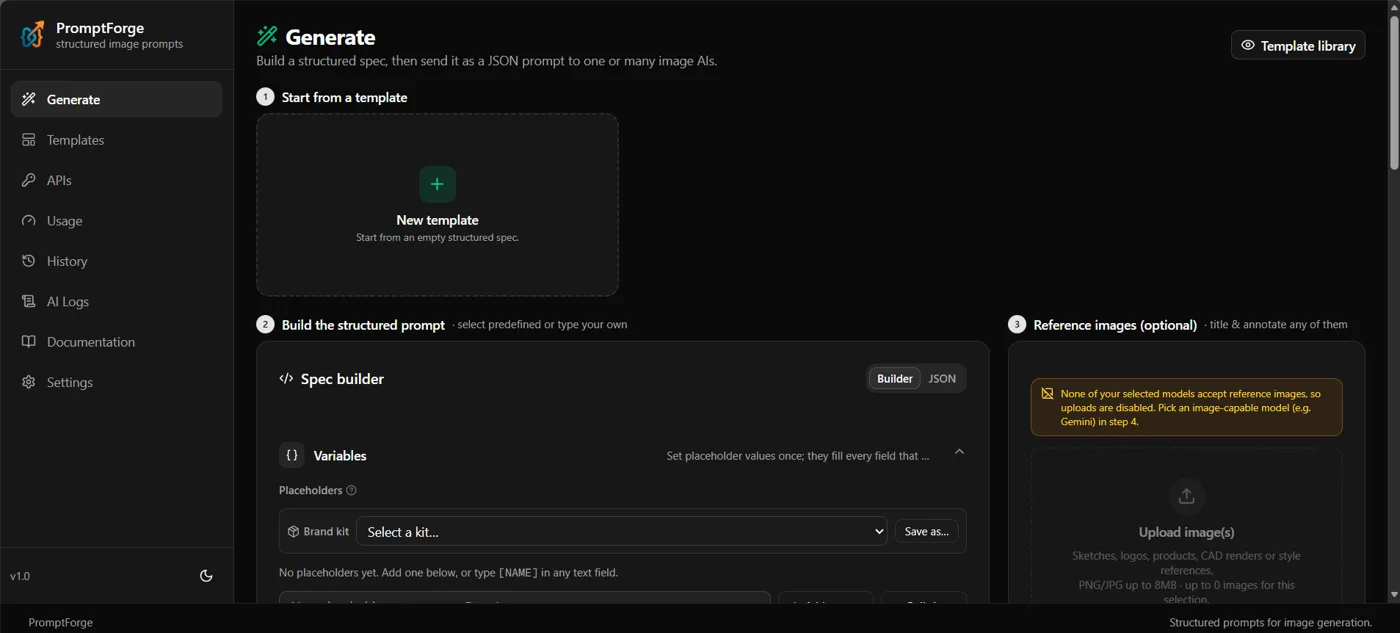
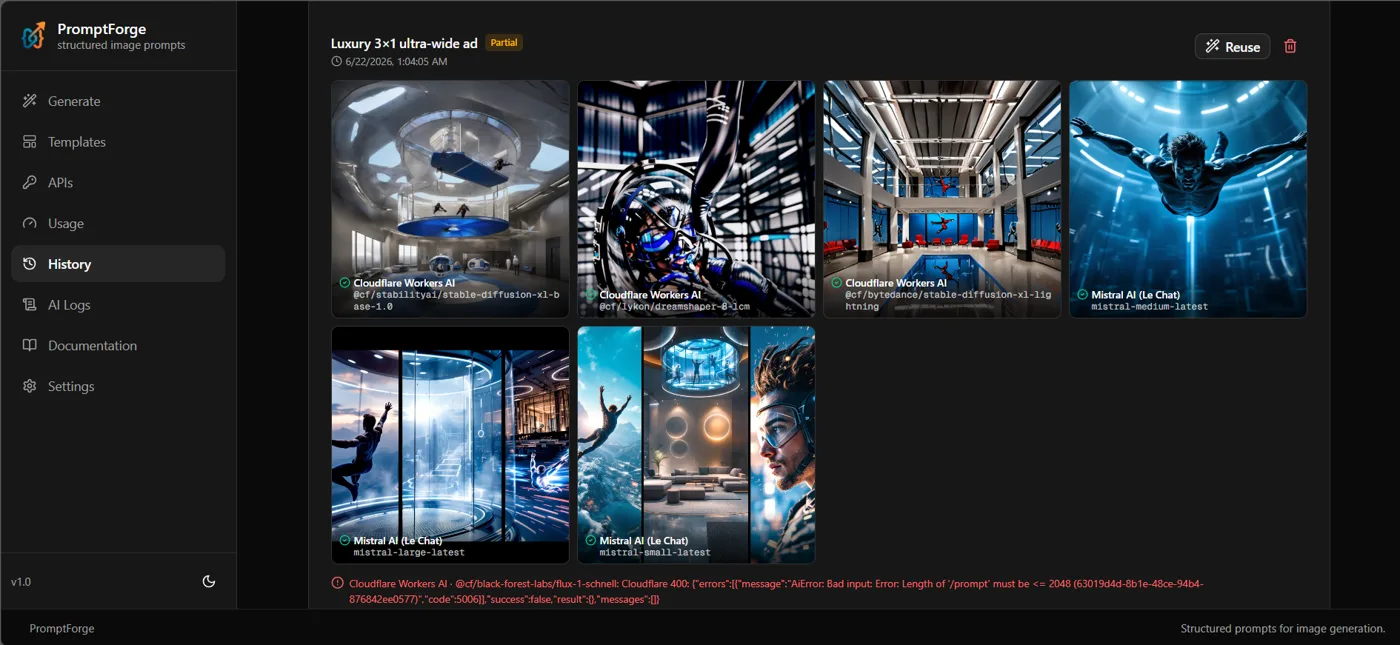
Built for a social media startup that needed to produce post images at volume. Write one structured prompt and generate images from many AI providers at once (OpenAI, Gemini, Stability, Replicate, fal.ai, Ideogram, Cloudflare, Mistral and others). Each request is adapted to what the chosen model supports.
- Per-model adaptation: each request is adjusted to what the chosen model supports (sizes and aspect ratios, negative prompts, reference-image limits, reasoning settings), so one prompt works everywhere.
- Built for team volume: templates with variables, brand kits, batch generation, and templates that can be shared and imported between users.
- Provider monitoring: each provider's remaining balance, rate limits and usage at a glance.
- Reliability: automatic retries, timeouts and limits on parallel requests; a failure at one provider never stops the others.
- Annotated reference images, full generation history, and API keys encrypted at rest (AES-256-GCM). About 22,000 lines of TypeScript.
PhoneCam: billboard detection for advertising research
Python · PySide6 · YOLO11/12/v8 · TensorRT · FFmpeg/NVDEC · OpenCV
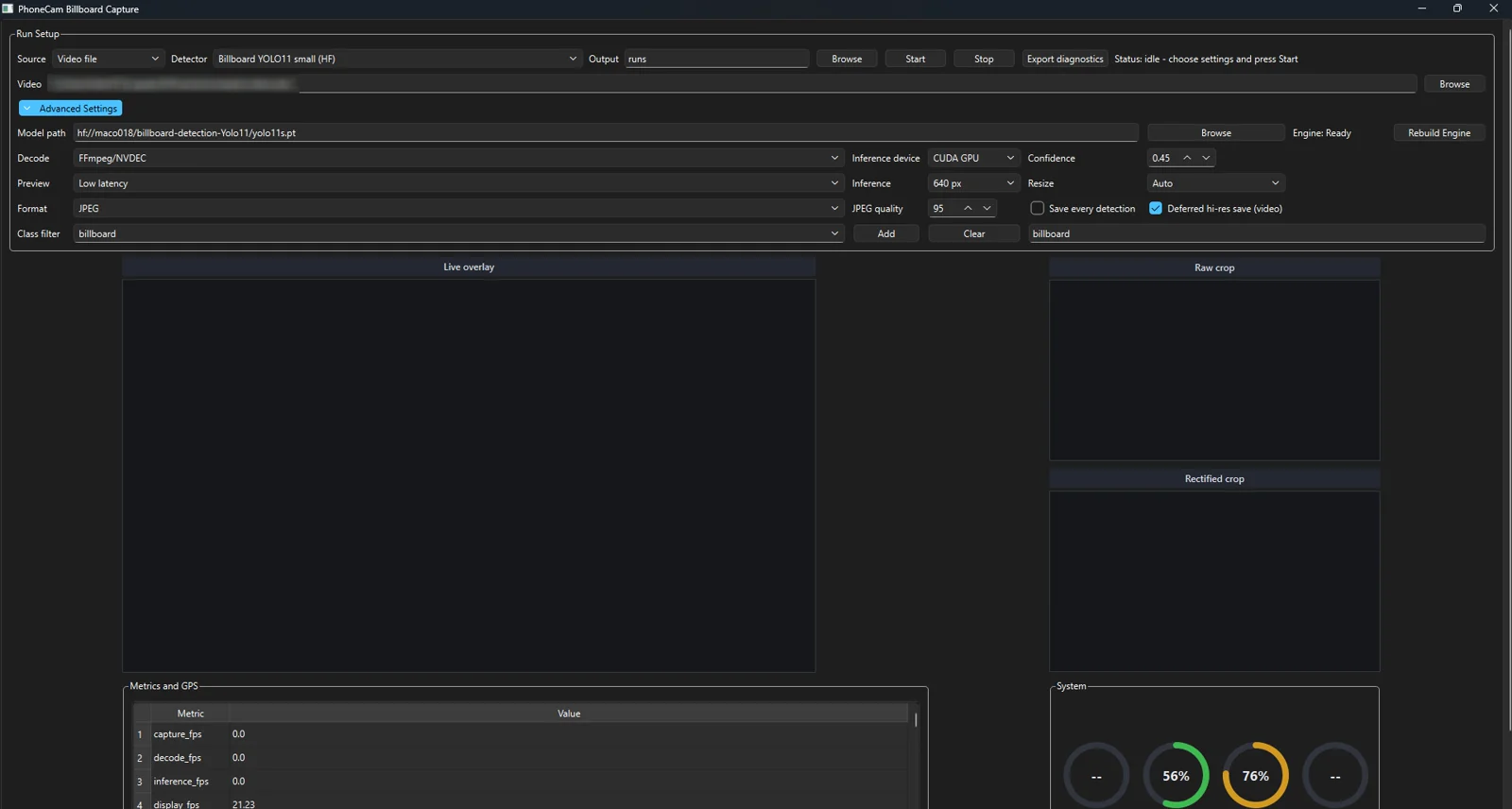
Freelance project for a university professor researching how advertising differs by location. A Windows desktop app that scans recorded video, detects billboards, and exports a folder of billboard images ready for a second AI tool that analyses their content.
- YOLO11, YOLO12 and YOLOv8 presets, including rotated boxes for billboards seen at an angle, with models downloaded on demand.
- Exports straightened, full-resolution crops of every detection. Removing duplicates is left to the analysis step, by design.
- An adjustable confidence threshold drops weak detections, so fewer false billboards end up in the export.
- GPU hardware video decoding and TensorRT engines built from inside the app, for fast processing.
- Speed, CPU, GPU and memory metrics for each stage, used to decide what to optimise next.
Polymarket trader analyser and strategy simulator
Python · WebSockets · Streamlit · Plotly · Polymarket and Binance APIs
Freelance project for a client who wanted to learn how successful traders work and test strategies safely. Enter a Polymarket account's wallet address and the tool pulls that trader's whole trade history, then breaks down how they trade. Strategies learned this way are then tested in simulators on live market data. It was used for research and simulation only, not live trading.
- Trade collector: pulls an account's history from Polymarket's API in 15-minute windows, page by page, skipping duplicates, until it has the number of trades asked for.
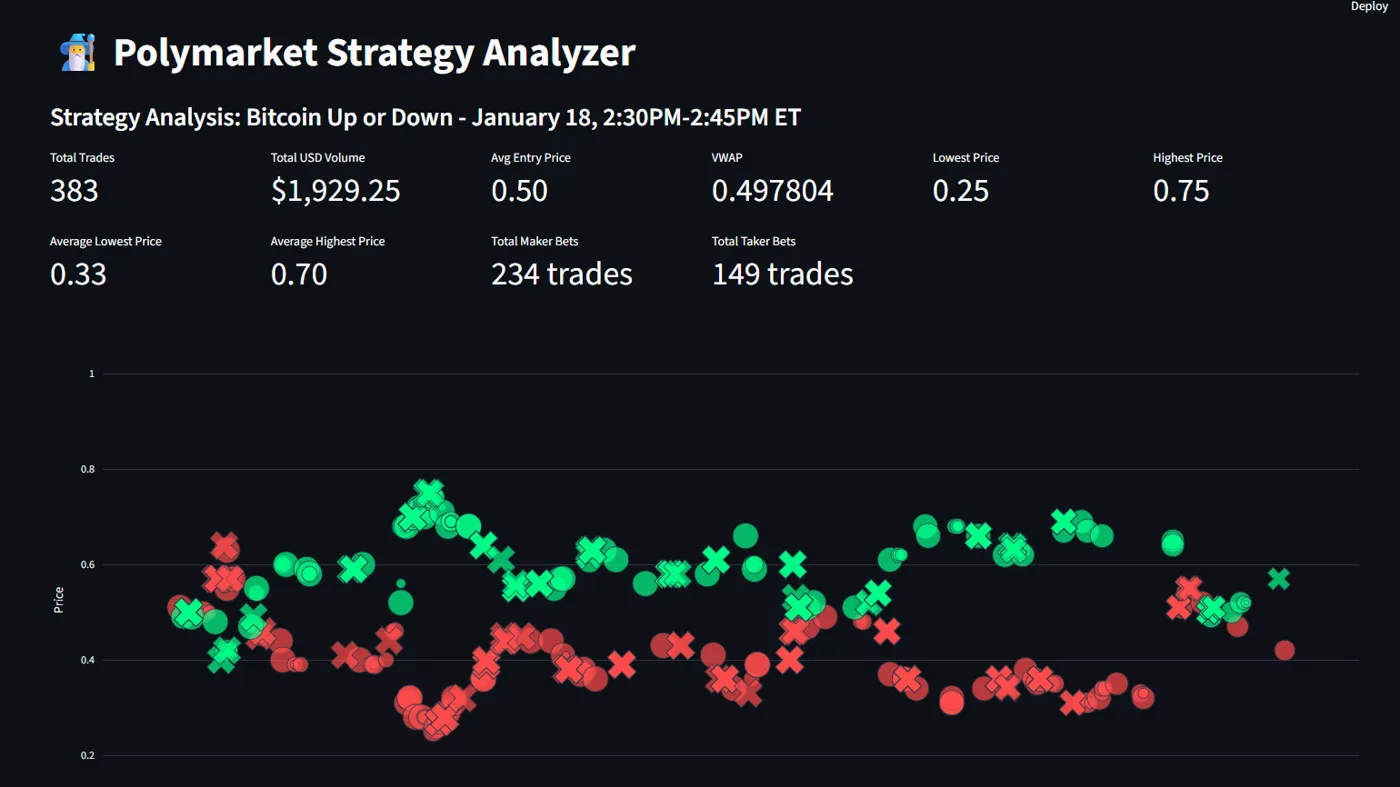
- Strategy analyser: per market or across all of them, it tells maker trades from taker trades, and charts entry prices, VWAP over time, and cumulative shares, profit and exposure, so the trader's strategy can be read from the data (Streamlit and Plotly).
- Strategy simulator: a 10-state decision engine that trades on live prices and order books in dry-run mode, with built-in risk controls: limits on open positions, total exposure and new entries per update, no new entries near expiry, trend confirmation before entering, liquidity checks before buying, and profit targets that adjust as expiry approaches, with hedging to lock in profit when a trade turns. The full logic is documented in a written specification.
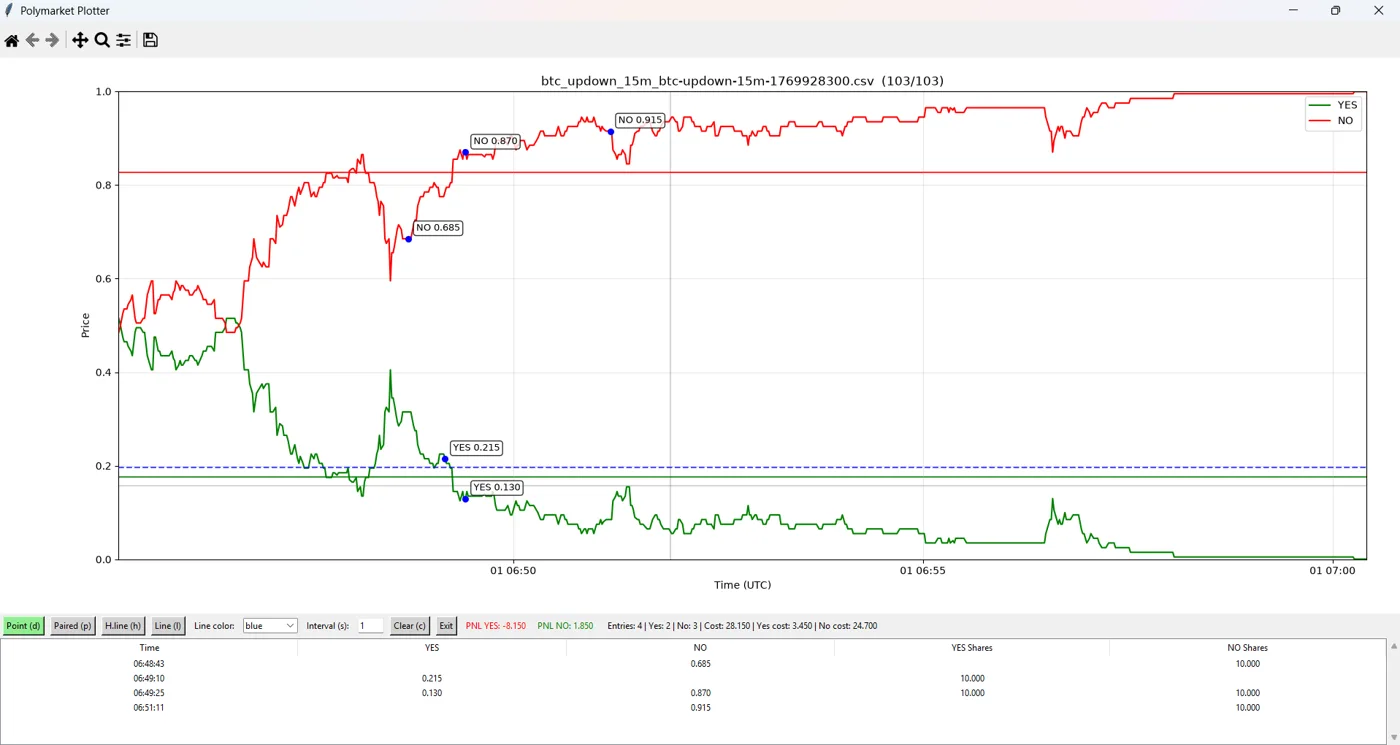
- Market recorder and replay: records Bitcoin 15-minute up/down markets, with an interactive player to replay them, a live view of every open position, and a dashboard that replays each simulated market's trades and profit.
ProMapper
React · Electron · SQLite
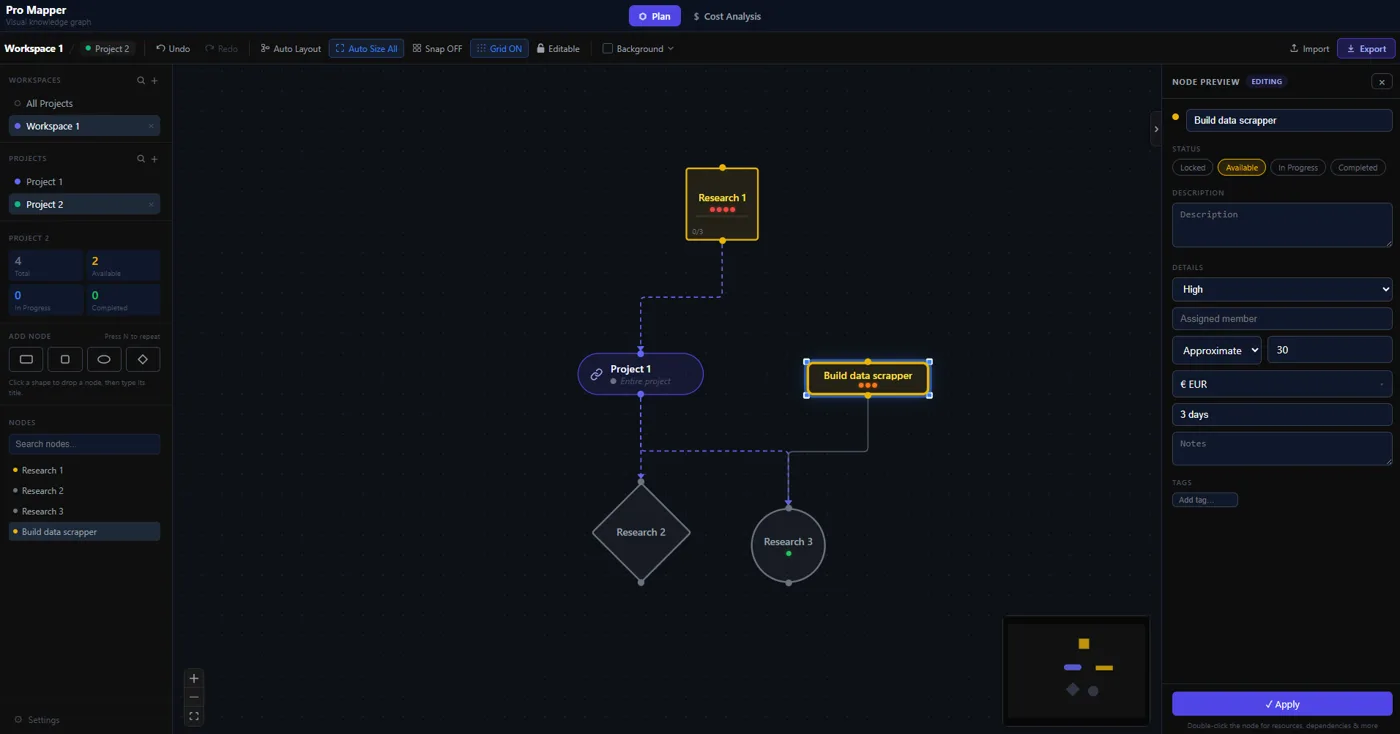
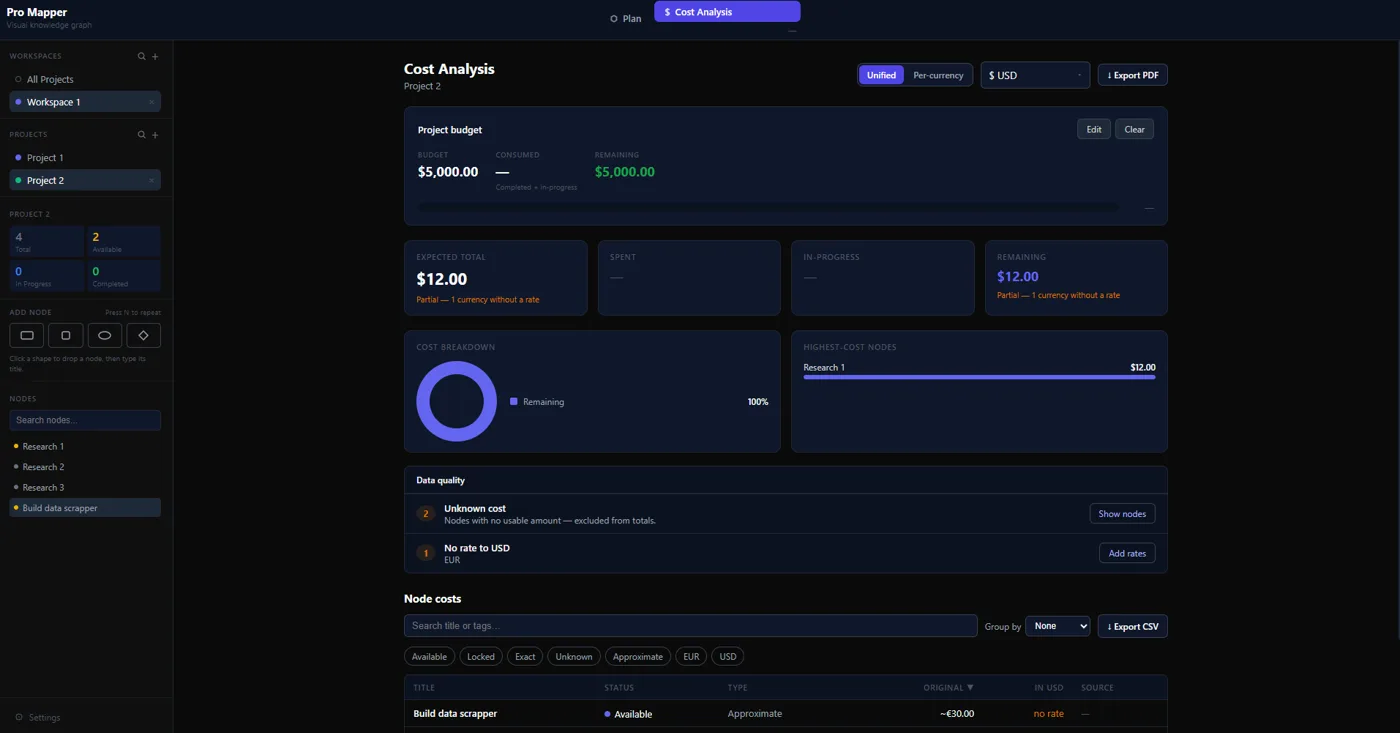
Built for a business advisor, who still uses it. Visual project planning: tasks as connected nodes with dependencies, statuses, costs in several currencies, and templates.
- Time, priority, notes and resource fields on every task, with progress tracking per project.
- Cost and budget tracking in several currencies, converted with live exchange rates.
- Reusable project templates and export to several formats.
Multimodal PDF RAG
LangChain · ChromaDB · OpenAI · Groq · Mistral
A personal project to help university students chat with their PDF documents, including text, tables and images. I compared models and OCR tools, and concluded that reliable answers from complex PDFs need better layout parsing and citation checks.
- Extracted text, tables and images from PDFs into a ChromaDB vector store (Unstructured, LangChain).
- Compared OpenAI, Groq (Llama) and Mistral models for answers and embeddings.
- Summarised each table and image with an AI model so they could be searched alongside the text.
- Tested Azure Document Intelligence and GMFT table detection for reading complex page layouts.
- Built a small chat interface for asking questions about the documents (Flet).
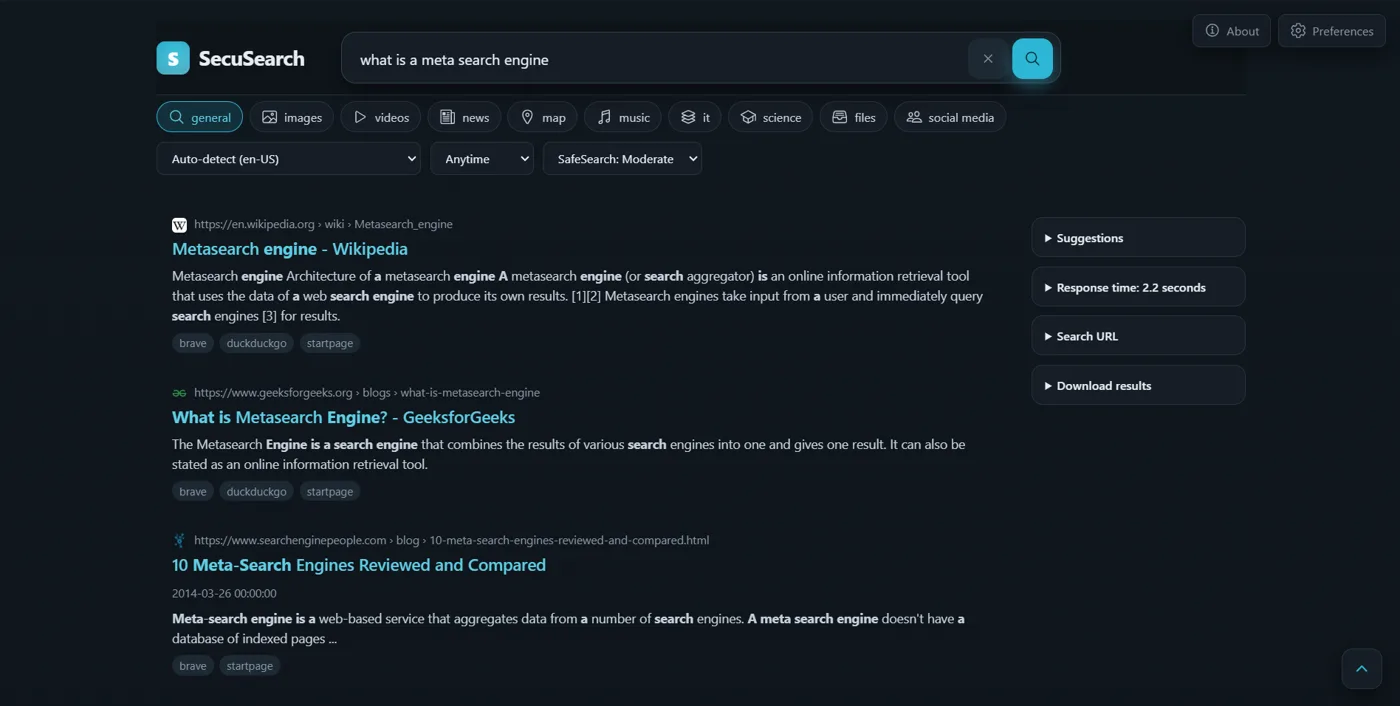
SecuSearch
Electron · SearXNG · Tor
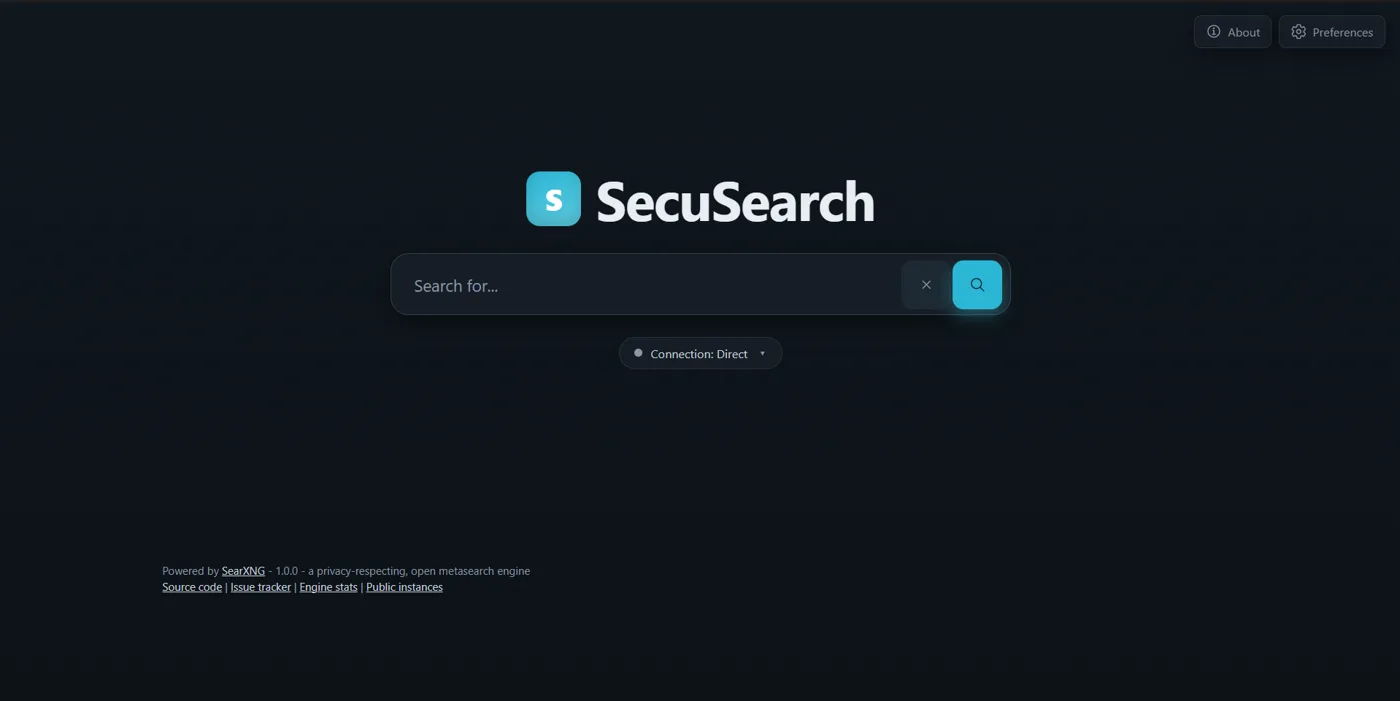
Freelance project. A privacy-focused desktop search app that combines results from many search engines and can route traffic through Tor.
- Results from Google, Bing, Yahoo and other engines in one place, without the engines tracking the user directly.
- Shipped as a one-click Windows installer with embedded Python, so non-technical users can set it up themselves.
Flight incident replay for a journalist
JavaScript · Three.js · uPlot · flight-tracking data
A journalist investigating the diversion of flydubai flight FZ1073 needed to see what happened. I merged data from two flight-tracking services into an interactive replay with a 3D view, a map, and altitude, speed and climb-rate charts.
- Play, pause and scrub through the flight, with every view kept in sync.
- A physics simulation of the cabin: it estimates the g-forces from the recorded data and shows how unbelted passengers would have moved between seats and overhead bins, with its assumptions stated on screen.
Arabic ID number reader (prototype)
Python · object detection · data augmentation
A test project at Ghandour Solutions for an ID-scanning device: detecting Lebanese ID cards and reading their Arabic numerals. I built the dataset, the augmentation and the training notebooks. It was shelved because reading Arabic numerals reliably needed stronger models than were available to us then.
Truck detection and gate control
Python · OpenCV · YOLOv5 · Arduino
A client of Ghandour Solutions wanted their gate to open automatically for trucks. The system detects and tracks trucks from a live camera and opens the gate through an Arduino relay.
Engineering and 3D
My background is in mechanical design and manufacturing, and I still build software for it.
Optiforge: AI-assisted CAD/CAE optimisation platform
C++ · CMake · Qt · VTK · OpenCascade
A freelance project for a researcher: a platform to help engineers improve mechanical designs using simulation, manufacturing constraints, material data, surrogate models and AI-assisted decisions. I wrote the full product requirements document, with stable requirement IDs, version scopes and verification rules, plus architecture decision records and a matrix linking every requirement to its tests. I then set up the codebase: twelve module skeletons with boundaries enforced at build time, four app shells, and early tests proving the core engines (Gmsh meshing, the CalculiX solver, OpenCascade geometry) worked together. The client halted the project at that point for lack of funding.
Interactive 3D vehicle viewer
React · Three.js · React Three Fiber · Blender
Freelance project for a client building an electric-vehicle app, who wanted to show each user a 3D model of their own car inside the app. It includes the full asset workflow: cleaning and compressing the models in Blender, exporting them for the web, and showing them in the browser. The finished code was handed over to the client.
- Works with any standard 3D car model (GLB/GLTF); the demo uses a BYD Dolphin.
- Shows loading progress while the model downloads.
- Orbit controls so the user can spin and zoom around the car.
CurveMill: CNC file optimiser
Python · PySide6 · C# SolidWorks add-in
Internal tool for Ghandour Solutions, built to fix a bottleneck in the company's CNC workflow. It cleans and repairs DXF cutting files and previews how the cutting tool will run. On real files it cut sketch elements from 3,383 to 540, and a 7,014-line pattern down to 274.
- Finds sketch faults (open profiles, duplicate lines, shared corner points) and shows each one as a clickable warning that zooms to it.
- Keeps curves as true splines through import, editing and export, instead of breaking them into small lines.
- Simulates the endmill cutting along the centre, inside or outside of a path, and repairs small gaps within a set tolerance.
- A SolidWorks add-in with its own toolbar, plus a pass that rejoins broken curves into whole ones.
- SolidWorks-style dimensions to place a pattern exactly on the board, a reusable pattern library, and project files to pause and resume a job.
- About 16,000 lines of Python, covered by 225 automated tests.
View the code on GitHub →
Electronics and home automation
Arduino · Raspberry Pi · Sonoff · sensors
Home automation for energy metering, automated curtains, climate control and safety, plus Arduino and Raspberry Pi prototypes that connect software to real hardware.